
Club Natació Barcelona and the Universitat de Barcelona Collaborate to Create the First Postgraduate Programme in Psychological Well-being and Blue Health
- Jun 26
- 3 min read
Water as a Space for Well-being, Inclusion and Transformation. The Club as a Real-Life Setting for Learning, Research and Knowledge Creation.
In recent years, the relationship between mental health, physical activity and natural environments has evolved from an intuition into a well-established field of scientific research. In this context, the concept of Blue Health—the physical, psychological, emotional and social benefits derived from interacting with aquatic environments—has given its name to the first edition of a postgraduate programme, with Club Natació Barcelona serving as its main collaborating institution.
Over the course of several months, Club professionals played an active role in designing and developing the programme's content, which was promoted by the University of Barcelona. More than just a postgraduate course, it became an opportunity to generate shared knowledge based on real-life experience—the experience lived every day at our facilities.
Water as a Therapeutic Environment
Scientific evidence is becoming increasingly clear: physical activity in aquatic environments promotes emotional regulation, reduces stress and anxiety levels, and enhances overall well-being. Swimming and other aquatic activities contribute to neuroplasticity, mindfulness and nervous system regulation, extending far beyond the cardiovascular benefits that often dominate the conversation.
Open water swimming adds a unique emotional dimension. The connection with nature, the sound of the waves and the feeling of openness create experiences of calm, resilience and well-being that are difficult to replicate in other settings.
Throughout the programme, the Club's sports psychologist and educational psychologist, Judith Tarracó, explored these benefits and presented CNB's aquatic programmes as real-world settings for health promotion. Open water swimming, aquagym and recreational swimming were approached not merely as physical activities, but as spaces that foster social connection, self-care and emotional regulation.
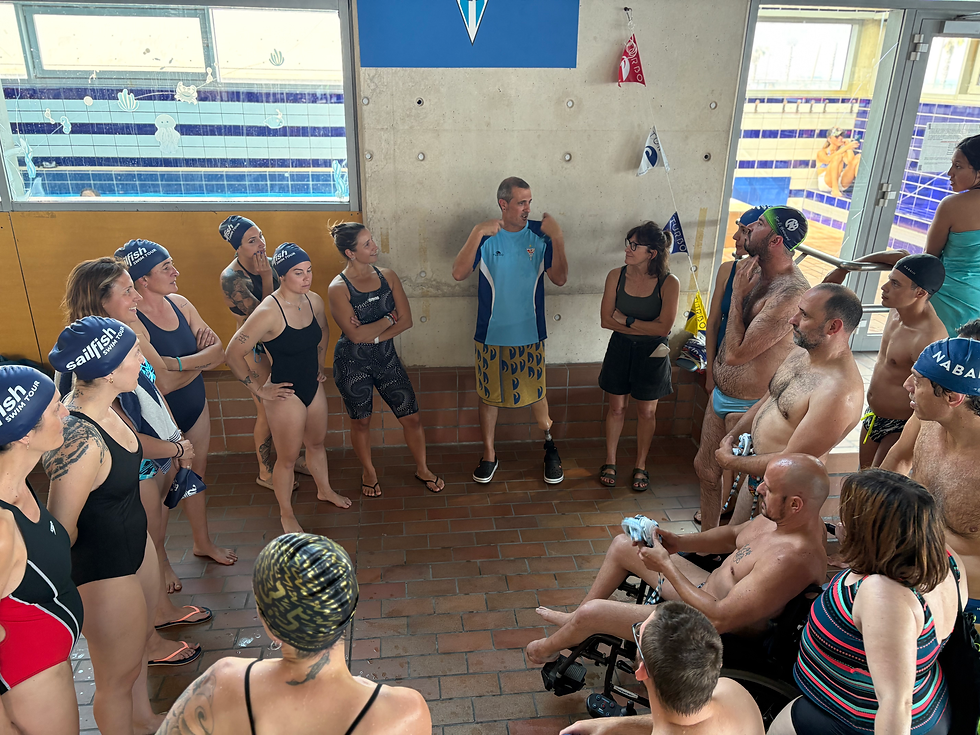
Students had the opportunity to experience these benefits firsthand during two practical sessions in the aquatic environment, where they took part in relaxation and body awareness exercises, open water swimming sessions, and aquagym activities from a mindful and therapeutic perspective.
Inclusion and Adaptive Sport: A Transformative Perspective
The postgraduate programme also included a dedicated module on aquatic programmes for people with disabilities, developed by the Club's Department of Pedagogy and Sport, led by Marta Noguera, with Elena Morillas contributing to the theoretical and educational content.
The session explored the evolution of adaptive sport at the Club and the changing social perspective on disability and inclusion: from a segregated model to an integrated one, and ultimately towards a truly inclusive model, where diversity is no longer viewed as an exception but as a natural part of the system.
For many participants, the practical sessions became the most meaningful part of the programme. Sharing training sessions and experiences with athletes and coaches from the Club's adaptive swimming and adaptive water polo teams provided a genuine insight into their daily reality through a human and relational perspective. Their testimonies highlighted that adaptive sport is, above all, a space for belonging, autonomy, identity and personal growth.

Launching Research on Well-being and Aquatic Environments
One of the project's most significant outcomes has been the development of an evaluation and data collection system linked to the Club's aquatic programmes. This initiative was carried out in collaboration with Albert Dalmau, an adaptive water polo athlete and statistical analysis specialist, together with coaches, families and athletes from several of the Club's programmes.
The first findings point in a clear direction: participation in aquatic activities is associated with improvements in perceived emotional well-being, quality of life, emotional regulation and sense of belonging. Although the research is still in its early stages, it represents an important first step towards building scientific evidence to support the therapeutic, educational and social value of what the Club has been promoting for many years.
A Closing Ceremony and the Beginning of a New Journey
On 29 May, Club Natació Barcelona hosted the closing ceremony of the postgraduate programme. The Club's General Director, Xosé-Carlos Fernández, thanked the University of Barcelona for the trust placed in the institution and emphasised the importance of continuing to promote projects that place people at the centre—projects that recognise sport and aquatic environments as powerful tools for fostering holistic health, emotional well-being and social inclusion.
According to everyone involved, this project marks only the beginning of a long but essential journey. Continuing to research and generate evidence on the benefits of aquatic environments is key to advancing towards more human-centred, preventive and community-based models of healthcare.
Because water is far more than a place for sport. It is a space for regulation, connection, personal growth and life.
Our sincere thanks to everyone who made this project possible: Marta Noguera, Judith Tarracó, Elena Morillas, Samuel Guerrero, Gonzalo Ezequiel, Rubén Reguart, Jesús Collado, Marc Gatius, and all the coaches, volunteers, athletes and families who contributed to bringing it to life.


Comments